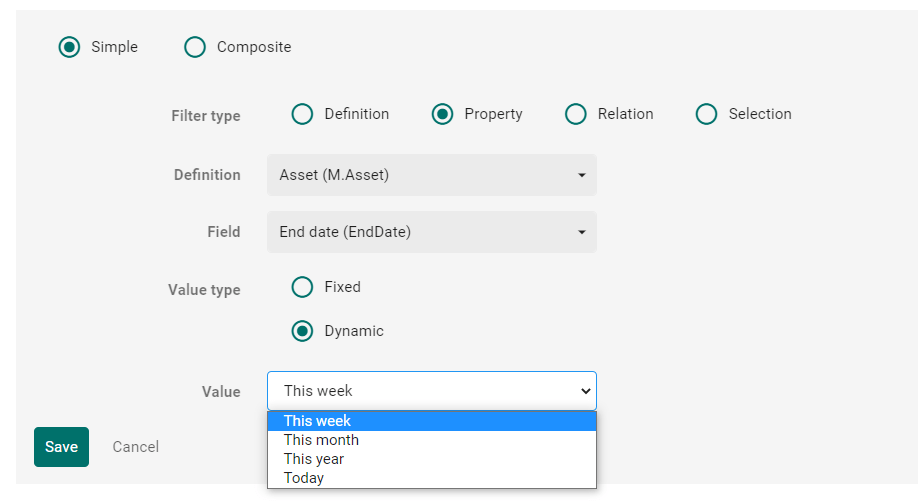
If you build a search page in Content Hub it is possible to have a filter for a date field of your entity. In the following case we want to show all assets which have an end date before today plus 30 days.
Out of the box it is possible to set a dynamic filter on a date field of an entity.
When you add a relation field in an entity and make this visible in the Entity details component on the Detail page you can see a default search, which is just a list of entities with a search field. But what if you want to enhance this search with facets e.g.? This blogpost will show you how to do this.
Sometimes in Content Hub scripting we need to read settings which are configured in Content Hub. You have to be careful, because you can crash the Content Hub. Following I will show you how to do this and what I did wrong.
If you want to setup your own usergroups and their permissions for CMP there are some things you have to consider. It is not enough to give them read or write access to M.Content. In the following paragraphs I will show you what you have to setup.
We all know the requirement, that fields are dependent on other fields. Also in Content Hub projects this can be a requirement for editing details of an entity. Following I will show how to solve this for two taxonomy members of an entity.
The use case is the following: We have a Taxonomy “Category” and a Taxonomy “Section”, both are related to M.Asset and Subcategory is dependent on Category. (We had discussed this example in Sitecore Slack Channel)
When it comes to creating different content types like blog articles, business reports or similar in Content Hub customers often need different workflows for the different types. In Sitecore Content Hub CMP there is one main state flow which you can configure. Following I will show you how to trigger different state flows.
Last time I wrote about our changes to the DAM connector to store extra fields in the XML raw value of the image fields in Sitecore. But what happens if these values are changed in Content Hub? We implemented storing the value in the moment we choose the asset from Content Hub. So we would have to choose again the asset which we changed in Content Hub? No way! Following I will show you our implementation of notifying Sitecore that something has changed and update the image fields in Sitecore.
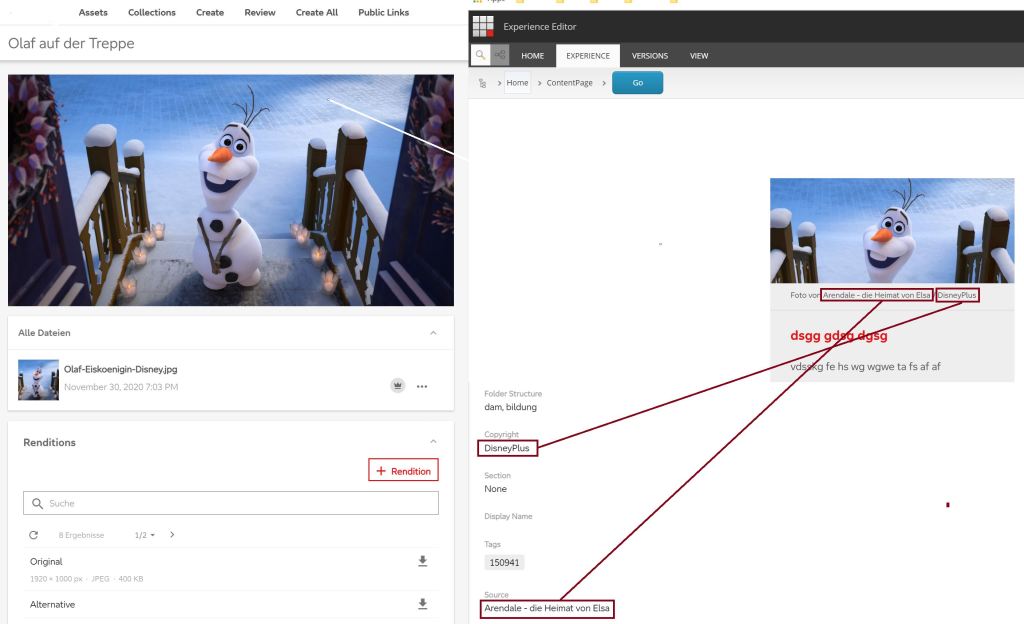
We all know the situation: Some images are restricted and we have to display their copyright and source in the image caption. Editors want to save this information only once. So, if you use the Content Hub they want to do it there.
The work in Content Hub itself is simple, just add two string-properties to the M.Asset-schema and you can edit them for the assets. But how do you get this information in Sitecore? The DAM Connector just comes with a few properties like asset ID, public link and the property you configured to use for alt text.
This blog post gives an idea of enhancing the connector for retrieving the additional properties you need.
Left: Content Hub Asset with Copyright and Source. Right: Preview in Sitecore, Teaser with rendered Copyright and Source.
In Sitecore we know that there is the possibility to add params like “mw” for maximum width and “mh” for maximum height. But what if we use Public Links from Content Hub? Spoiler: There is such funcitionality! In this blogpost we’ll have a short look into the hub and its possibilities.
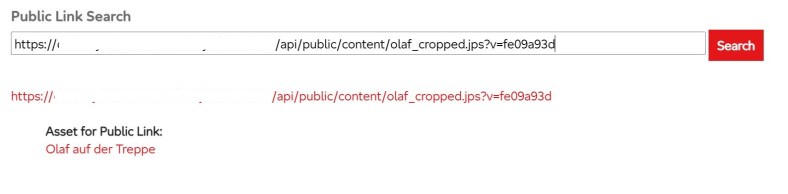
When using the assets from Content Hub there is currently no way ootb to find the asset for a public link. But this is a feature, which could be very senseful, so I tried to find out what we can do in Content Hub for achieving the goal. We can’t configure it in the search component used on the assets page for example. So I tried the way with a new page and an external page component and here is what I found out:
 Anna's blog